



Book Review
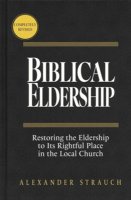
Biblical Eldership: Restoring the Eldership to its Rightful Place in the Local Church
Alexander Strauch has produced a completely revised edition of his widely sold and distributed, Biblical Eldership: Restoring the Eldership to its Rightful Place in the Local Church. In its original 1986 release and previously revised editions, this book’s subtitle was, An Urgent Call to Restore Biblical Church Leadership. While the wording of the subtitle may have softened, Strauch still presents a vigorous argument for what he sees as the biblical form and function of local church government.
The book has an easily-read style, an exposition which is almost homiletical in places. The reader, however, should not let this approachable style cause him to miss the consistent, well-formed New Testament arguments Strauch exposits. As a local pastor of many decades, Strauch ably demonstrates the skill of examining the New Testament theology and practice of ecclesiology in-depth without obscuring his meaning behind theological jargon more appropriate to the academy. The book is written for the average reader, specifically for those wanting to understand and practice a New Testament form of elder leadership or to teach it a group of leaders. To that end, the bulk of the book is an exposition of pertinent New Testament texts found in Acts, Philippians, 1 Timothy, Titus, 1 Peter, James, 1 Thessalonians, and Hebrews—presented in that order. Following these chapters of expositions is a chapter listing fifty-three summary points. Strauch’s exposition is well researched as evidenced by the pages of endnotes appended to the main text whose authors include many respected scholars and other noteworthy writers. Among the many who are cited are Church fathers; Puritans; New Testament scholars such as F. F. Bruce, Ralph P. Martin, Andreas Köstenberger, and D. A. Carson; and a host of more pastoral authors. These sources are in addition to significant exegetical commentaries and standard Greek lexicons.
Biblical Eldership begins with a clear overview and clarification in the book’s introduction as to what is meant by biblical eldership. Strauch’s New Testament model for church elders comprises three characteristics: shepherd elders as opposed to a corporate board—pastoral leaders; shared leadership of equality yet with functional diversity; and biblically qualified leaders as per 1 Timothy 3:1–7, Titus 1:6–9, and 1 Peter 5:1–5. After this overview, the book is divided into eleven main sections: Restoring New Testament Leadership; Luke’s Record of the First Christian Elders; Paul’s Final Charge to the Ephesian Elders; Who are the Overseers at Philippi?; Biblical Qualifications for Pastoral Overseers; Showing Double Honor; Protecting and Discipling Elders; The Biblical Qualifications for Pastoral Elders; Shepherding God’s Flock in God’s Way; Praying for the Sick; and Loving, Honoring, and Obeying the Elders. The titles of these eleven main sections are headings for thirty total chapters, most running about ten pages. This makes the book one which the reader can consume in small bites.
In section one, Restoring New Testament Leadership, Strauch lays out a clear vision in five chapters for what he expounds in the remainder of the book: New Principles for Leadership, Pastoral Leadership, Shared Leadership, Qualified Leadership, and Male Leadership. Strauch’s section entitled New Principles are a refreshing rehearsal of a biblical charge for local church leaders to be humble servants, serving together in brotherly equality, while exhibiting Christlike love. This humble servanthood is a theme that repeats throughout the book. He rightly critiques the strongman model which is found in many local churches just as he earlier critiqued the corporate board model. And yet, Strauch critiques in a pastoral manner, exhibiting the servant attitude he encourages local church elders to have. He also interacts with other local church leadership models in the same straight-forward, but pastoral manner in other parts of the book.
Strauch’s presentation is both straightforward and centered on the New Testament. Accordingly, any reader who would disagree with Strauch’s model for ecclesiology must engage primarily with the New Testament text, and therefore must counter with other New Testament passages or advocate a model which developed outside the apostolic era, either one drawn from the Old Testament or one which developed after the death of the last apostle near the end of the first century. When Strauch delves into the qualifications of an elder such as those listed in 1 Timothy 3, he provides short word studies of the Greek to include how various English-language Bibles have translated the word in question. Here, as in the other passages he considers, the reader can see that Strauch has done his homework. But his is not a dry rehearsal merely comprising word studies. Once the definition is presented, the reader can perceive the years of pastoral care which the author has provided. Accordingly, Strauch not only explicates the meaning of the New Testament text, but the practical outworking of the trait listed for a biblical elder, complete with vignettes from local church ministry.
A question pertinent to this journal’s readership is the applicability of Strauch’s model. Specifically, is this book only useful in a North American, evangelical subculture? The history of publication and subsequent reaction since 1986 would answer, “No.” To date, editions of Biblical Eldership have been used throughout the world and published in twenty different languages across a wide spectrum of denominations. This newly revised edition has been translated thus far into German, Hindi, Hungarian, Russian, and Spanish, with French soon to join the list. Furthermore, if one were to check the publisher’s website (https://www.biblicaleldership.com/), the reader would find letters of appreciation from many different continents. And the readers of the journal should check the website because it contains a wealth of resources on offer such as books concerning elders, deacons, marriage and family, and workbooks to study through much of the same. Spanish speakers also will find many of these same books available in translation. Finally, visitors to the website will discover the School of the Shepherds, an opportunity to enroll in online learning about local church leadership.
The only “major” critique by this reviewer is the use of endnotes rather than footnotes, especially given their value for further research into Strauch’s argument. Then again, the reviewer’s work as an academic is betrayed in this critique, and so his comment is likely not germane for most readers.
Biblical Eldership stands as one of the best, if not the best, resources available that treats this topic. Accordingly, Biblical Eldership is a strongly recommended book for any who are interested in a New Testament form of local church leadership. This new edition also belongs in the library of theological schools as a resource for research into models of ecclesiology.


