



Book Review
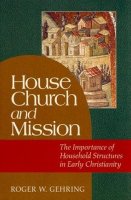
House Church and Mission: The Importance of Household Structures in Early Christianity.
This exhaustive work is a translation of the author’s year 2000, German-language PhD dissertation Hausgemeinde und Mission: die Bedeutung antiker Häuser und Hausgemeinschaften von Jesus bis Paulus with all the strengths and challenges inherent in this type of literature. Right away, however, the reader should note the good news that the book’s author is the translator of this work so the reader can have a greater confidence in the nuances of the translation. According to the book’s back cover, the author was a longtime Campus Crusade for Christ staff member at a number of universities in the US and Europe, and he was an adjunct professor at George Fox Evangelical Seminary in Portland, Oregon when the book was released.
Gehring traces the use of houses from the ministry of the Lord Jesus in the Gospels before the foundation of the Church through the ministry of the Apostle Paul as he planted churches throughout the Mediterranean world. What makes this work particularly useful is that Gehring interacts not only with the text of the New Testament but with writers great and small who have commented upon the use of the house and household structures in the time of the Lord Jesus and the Apostle Paul. Pertinent to the readers of this journal are some of the questions posed directly or indirectly by Gehring’s work such as the tight relationship between leadership recognized in the local church and ownership of the structure in which the local church met. These questions may get particularly uncomfortable for some as he presents his perception of the role of women in the local church in relation to those who owned the buildings in which the early Church met.
Gehring’s work is not for the faint of heart given the rigorous academic style and presentation of this book. For example, he delves heavily into the literature of languages other than English as he carefully unfolds the product of his research. Each page is replete with footnotes, and some sixty-plus pages of bibliography follow the text. Additionally, the reader would be well-served to have a working knowledge of Greek if he hopes to gain the most from this text. Nevertheless, the reader who works through the book will be well-rewarded by the careful, thoughtful analysis of the importance of the house in the spread of the gospel. For those with less time or patience, Gehring ends each major chapter with an excellent summary and also has included interim summaries throughout each chapter at appropriate points. His final chapter deals with the function and significance of the house for the mission of the Church in relation to its architectural, socioeconomic, and ecclesiological significance. Moreover, his last thirteen pages are a marvelous application of his study for the use of the house church model today where he outlines both the wonders and worries of this model in our postmodern era. This last chapter, and especially the last thirteen pages, should be high on the reading list of any local church which contemplates using the house church model or is looking for a helpful, thought-provoking interaction because it is searching for various ways in which to penetrate the local community with the gospel.
While this book is recommended for those with the requisite skill sets mentioned above, obtaining a personal copy will be a challenge. Like many worthwhile volumes, this one has gone out of print. A trip to a local theological library most likely will provide the readiest access to a copy. For those who would like a personal copy, one should check the used book market. This is why the price is listed as “varies” above. Perhaps the best place to check for a personal copy is the aggregator of a vast multitude of used book sites worldwide, AddAll, found at https://www.addall.com/used/. This site is mentioned not only for this volume, but for any others for which a reader of the journal may be interested. While Gehring’s work is not available at Internet Archive, this site, too, is always worth a look, especially for those who do not have access to a comprehensive theological library. Internet Archive (https://archive.org/details/texts) not only houses books and makes them available at no cost, but this online library also includes many journal and magazine articles.


