



Book Review
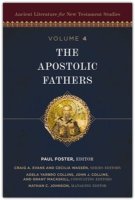
The Apostolic Fathers
Inquiry into the teachings and situation of the ancient Church era is trending among evangelicals in these days. A growing realization has come that today’s Church stands on the shoulders of those who have gone before, and well before the Reformation. But where can one start, or how can a classroom teacher introduce this early era to a classroom of students?
A good starting point is a new work edited and contributed to by a premier scholar of this era, Paul Foster’s The Apostolic Fathers. The reader should note that this is not a reworking of 2007’s The Writings of the Apostolic Fathers, also edited by Foster. In fact, the work of only one of the contributors to the 2007 collection of essays appears in this new work. The Apostolic Fathers is a newly released work, volume 4 in a projected 10-volume series from Zondervan Academic, Ancient Literature for New Testament Studies, joining volumes 7, 9, and 10 already in print. Before reviewing the contents of this latest volume, however, Zondervan should be commended for undertaking this series as a whole. Further, if Foster’s volume is any measure, this series will become a standard set for any student of the ancient Church during either the apostolic era or immediately following. The contents and format are useful to the non-specialist who wants more than a cursory introduction, to the professor looking for a well-written work that can be used to guide a class through the pertinent issues, and to the specialist looking for a ready resource to peruse current scholarship. Foster has gathered a cadre of well-published—some even award-winning—authors to explore this body of literature.
What may may come as a surprise to some of this journal’s readers is that the Apostolic Fathers are not merely an identifiable group of men, but a collection of writings whose authorship may or may not be known. As Foster notes in his introductory essay, “‘Apostolic Fathers’ is a dual reference” (p. 4). As with a number of issues related to Church history, the term “Apostolic Fathers” was a moniker given to this assemblage as the collection was “codified” in 17th century. Even then, the contents of the collection varied as to which recension of a writing should be included in the collection. Further complicating the codifying of the collection was that some of the writings were included in early collections of New Testament writings, though not widely and sometimes only appended after the canonical texts. These issues and more are treated in The Apostolic Fathers in a clear, easily-read manner—and this is part of the genius of this work. Anyone with rudimentary theological acumen can follow the arguments presented.
For those wanting further, deeper study, copious footnotes are found throughout (not endnotes; kudos!) as well as a bibliography following each chapter of the book. In addition, an extensive bibliography of various editions of the Apostolic Fathers as well as current scholarly studies and articles is affixed to the book’s end. Hopefully this excellent bibliography will be updated continually via revised printings, or perhaps provided with a link to an online listing which is continually updated.
The book is divided into two main parts following Foster’s introduction: a treatment of the texts themselves and a survey of theological themes throughout all the writings. Foster’s introduction is a masterpiece, providing a wealth of information on the apostolic fathers. He rehearses the second-century setting, the identity of the apostolic fathers, and how the collection came to be. These are followed by expansive sections on the various individual texts and collected editions in print. He ends his overview with a section treating scholarly resources for study and a final section on the value of studying this literature. These mere twenty pages should have a firm consideration for any course or overview treating the Apostolic Fathers.
The eleven chapters in the first main part treat each of the texts individually, or in the case of Ignatius, the collection of his letters. The chapters follow a suggested chronological order in which each book was written. For those familiar with Michael Holmes translation of the apostolic fathers, a standard and much recommended translation, the order is somewhat different. Nonetheless, this multi-authored work edited by Foster provides great insight into the earliest decades of the Church from the latter part of the first century to the middle of the second irrespective of the order of appearance. Each chapter treats one of the apostolic fathers, or the collection of the letters of Ignatius. Helpfully, each chapter presents the same pattern, being divided into five main sections entitled Introduction, Summary of Content, Interpretive Issues, Key Passages for New Testament Studies and Their Significance, and Conclusion. The subsections underneath the five main headings vary according to the writing under consideration as well as the chapter’s author. For those wanting a quick overview of the Apostolic Fathers, every chapter’s Conclusion is complete enough to provide a good feel for the writing at hand without being overly lengthy.
The last eight chapters treat the apostolic fathers as a whole, presenting their theological themes. The themes treated are Christology, soteriology, ecclesiology, eschatology, women and gender, ethics and education, martyrdom, and the writings of the New Testament in the Apostolic Fathers. While all these chapters do not follow the same rubric, each chapter is written clearly and divided into appropriate main headings. Like the presentation in the aforementioned eleven chapters, almost all of these last eight chapters terminate with a helpful conclusion; and again, all these chapters have a bibliography appended after their conclusion. Given that these chapters are a synthesis of a theological theme, most of these conclusions are a bit longer than in the preceding eleven chapters. Nonetheless, a reader can gain a good overview of the theological themes treated by reading just the conclusions.
No reader should be surprised at this juncture that The Apostolic Fathers is a highly recommended addition to any school’s theological library as well as to the reader who wants to dig deeper into these early writings from the ancient Church era. Whether the acquisition is the handsome hardback or an electronic edition, the purchaser can be sure that this will be money well spent.


