



Book Review
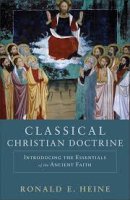
Classical Christian Doctrine: Introducing the Essentials of the Ancient Faith
Among the challenges facing the modern believer is the sense of disconnectedness from the Church just after the time of the apostles most often due to a significant lack of knowledge about the beliefs and practices of the Church after the close of the apostolic era. What little may be known to some believers often can be a hostile rendition of those times. As in any era of Church history from Acts 2 to the present day, the centuries immediately after the apostolic era had noteworthy weaknesses and challenges. Readers should remember, however, that, even while the apostles lived, some in the local church followed a false gospel and so were corrected quite sharply in the opening verses of Galatians! Nonetheless, the first four centuries following the formation of the Church in Acts 2 saw the formulation of many of the still commonly-used understandings of the fundamentals of biblical Christianity. While the Bible certainly teaches doctrines such as the Trinity as well as the full humanity and full deity of the Lord Jesus Christ, how were these mysteries to be explained both to those within the Church as well as those opposed to the gospel of Jesus Christ? Additionally, the redemptive work of Christ, the definition of the Church that the Lord said he would build, and matters related to the eschaton needed further explanation as differing views arose from a variety of sources.
Heine’s work, then, is a primer which introduces the ancient Church’s discussions in addition to the people and events which lay behind the commonly-accepted teachings concerning the Scriptures, the Trinity, the person and work of the Lord Jesus Christ, the definition of the Church, and the eschaton. Heine’s selection of topics and their order of presentation follows the Nicaean Creed, a statement of belief which comes from the first post-apostolic gathering of Church leaders throughout the Roman Empire, a gathering which was held in Nicaea in AD 325 (p. 3). The exceptions to this pattern are the introductory chapter and the one which immediately follows concerning “Christian Scripture.” As the author notes, while the Scripture was not part of the belief statement released at Nicaea, nonetheless those who helped to form and subsequently accepted the statement of Nicaea had an approach to the Bible which underlay their thinking (p. 11). Accordingly, this topic is important if the reader is to have a proper introduction of the beliefs and practices of the early, post-apostolic Church. Heine does well to note the tight connection between the explanations of the beliefs of leaders from the ancient Church era and the Bible. This simple, but important observation is a pertinent reminder to a modern readership whose beliefs often are guided by an ever-changing personal truth or to those with an unbending commitment to cultural or time-bound traditions which do not reflect the teachings of Scripture. This is especially true of the chapter on baptism (chap. 13) which records a rapid and increasingly complex divergence from the teachings of the New Testament. The author notes a change from an immediate baptism after confession of faith to one which occurs after years of instruction and preparation to include multiple exorcisms (p. 150), and eventually to the belief that one cannot have salvation without baptism (p. 153)!
Heine’s style is easy to read; simple, but not simplistic—the mark of the writing of a good teacher. Each of the book’s short fifteen chapters begins with an appropriate text of Scripture central to the matter under discussion as well as a clear identification or definition of the following people and sources as marked out in a table prior to the chapter’s text. At the end of each chapter is a series of questions suitable for group discussion or personal study. Very helpfully, a list of resources for further reading ends each chapter after the discussion questions. Thus, the reader or a group of readers easily can begin to dig deeper if this is desired. No surprise, then, that this book is recommended to the readers of this journal.


